
Residential heat pumps offer a more energy-efficient solution for both space conditioning and water heating compared to conventional electric resistance or natural gas systems. However, homeowners retrofitting existing systems may face the added challenge of electrical service upgrades, which can increase costs and delay installation.
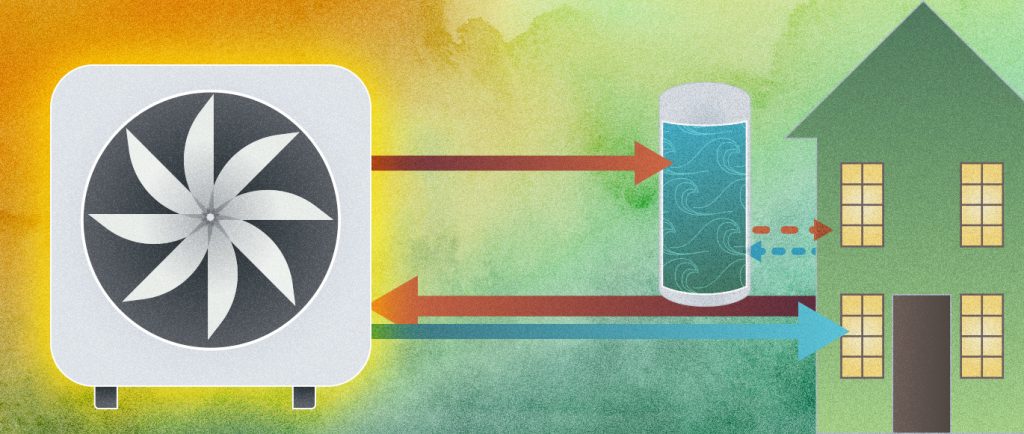
Multi-Function Heat Pumps (MFHPs) address this barrier by combining space conditioning and domestic water heating into a single system using one efficient compressor and outdoor heat exchanger coil. By reducing peak power demand relative to separate heat pump systems, MFHPs are more likely to operate within the limits of existing electrical panels on one circuit, minimizing the need for costly upgrades.
Some MFHP models can also capture waste heat from space cooling to heat water, improving overall energy efficiency. Additional gains in efficiency and thermal comfort may come from MFHPs equipped with defrost modes that draw heat from the water storage tank to defrost the outdoor coil during winter.
Despite these potential advantages, air-to-air MFHPs have not been studied in detail to evaluate opportunities for improvement or their suitability for the California and broader U.S. market.
Current Work
2025 Laboratory Testing
We evaluated the performance of a residential single-speed air-to-air MFHP through controlled laboratory testing. The testing assessed the unit’s capacity and energy consumption across multiple operating modes, including space cooling, space heating, water heating, simultaneous space and water heating, and defrost.
By testing the MFHP under outdoor conditions representative of different climate zones, the project aimed to develop accurate performance curves for each mode of operation during both winter and summer. These curves will support future studies in estimating the potential energy savings and grid impacts of MFHP technology in residential applications.
Results
Single Speed MFHPs
The project successfully tested the residential single-speed MFHP in WCEC’s environmental chambers. Testing covered a range of outdoor conditions, including those specified by AHRI 210/240-2023 and ASHRAE 206-2024 standards, as well as additional conditions tailored to California climate zones.
Under standard test conditions, the MFHP achieved a space cooling capacity of 45.3 kBTU/h at a coefficient of performance (COP) of 3.57, and a space heating capacity of 49.9 kBTU/h at a COP of 3.48.
Water heating performance followed expected trends, with capacity and COP decreasing as tank setpoint temperatures increased. In dedicated water heating mode, the unit achieved a first-hour rating of 82 gallons and demonstrated higher efficiency than electric resistance heating, except under extreme conditions.
Testing also revealed that the refrigerant-to-water heat exchanger was undersized relative to the compressor. Improving the water heating tank design is expected to enhance performance without increasing cost.
In simultaneous space cooling and water heating mode, the MFHP achieved notable efficiency gains—saving an average of 38% in electrical energy compared to operating the modes separately. Defrost testing showed faster completion times and lower peak power than typical single-speed heat pumps, improving compatibility with existing electrical infrastructure.
Variable Speed MFHPs
Space Cooling: In space cooling mode, at outdoor temperature 95°F db and indoor temperature db/wb 80°F /67°F, the variable-speed MFHP space cooling mode with full compressor speed of 53Hz provided a total cooling capacity of 7.28 kW (24.84 k Btu/h, 2.07 ton) at a COP of 3.42 with sensible heat ratio of 0.699. This performance is slightly better than the European ratings test data of 7.1kW cooling capacity at a COP of 3.40. At these same outdoor and indoor conditions, minimum compressor speed of 15 Hz provided a cooling capacity of 1.91 kW (6.53 k Btu/h, 0.54 ton) at a COP of 3.61, and at 28 Hz provided a cooling capacity of 4.60 kW (15.68 k Btu/h, 1.31 ton) at a COP of 4.32.
Space Heating: In space heating mode, the variable-speed MFHP performed reliably, even at low outdoor temperatures. At outdoor temperature db/wb 47°F/43°F and indoor temperature of db 70°F, the variable-speed MFHP SH mode with full compressor speed of 49Hz provided a heating capacity of 7.28 kW (24.8 k Btu/h, 2.07 ton) at a COP of 3.96. This performance is slightly better than the EU ratings test data of 7.1kW heating capacity at a COP of 3.90. At these same outdoor and indoor conditions, the variable-speed MFHP with minimum compressor speed of 15 Hz provided a heating capacity of 2.39 kW (8.16 k Btu/h, 0.68 ton) at a COP of 4.69, and at 25 Hz provided a heating capacity of 3.83 kW (13.2 k Btu/h, 1.07 ton) at a COP of 4.90.
Water Heating: As expected for all heat pump water heating equipment, the laboratory test measured water heating capacity and COP at a given outdoor air temperature decreased as water tank setpoint temperatures rose. In water heating mode, at 47°F db outdoor temperature, when heating water from 105 to 115°F water tank temperature, provided a capacity of 8.3kW (28.3 k Btu/h) at a COP of 2.46. The variable-speed MFHP achieved an estimated first-hour rating of 86.4 gallons.
Heat Recovery: Heat Recovery mode with simultaneous space cooling and water heating achieved higher COP than the separate space cooling and water heating modes. For indoor temperature db/wb 80/67°F, the simultaneous mode saved an average of 33 percent of electrical energy compared to performing space cooling and water heating separately heating the water tank from 110 to 120°F at outdoor temperature db/wb 95/75°F. Heat recovery mode provided space cooling capacity similar to dedicated space cooling mode and water heating capacity lower than dedicated water heating mode for dedicated modes at outdoor temperature db/wb 95/75°F.
Bi-Heating: In Bi-Heating mode, with simultaneous space heating and water heating, the variable speed MFHP manufacturer controls select compressor speeds higher than for either the separate SH or WH modes at the same conditions. At OA db/wb 47°F /43°F and IA db 70°F , heating the water tank from an average temperature of 80°F up to 120°F , the variable-speed MFHP Bi-Heating mode with compressor speed of 78Hz provided an SH capacity of 7.0 kW (23.9 k Btu/h, 2.0 ton) and average WH capacity of 4.5 kW for a combined COP of 3.36. There was not a significant difference between power consumption or COP for Bi-Heating compared to the estimates for separate modes delivering the same SH and WH capacity.
Defrost: Defrost operation for the variable-speed MFHP uses the refrigerant compressor to move heat from the hot water tank to the outdoor coil to melt accumulated frost. Defrost of the outdoor coil was completed in just under ten minutes with an average power of 1.8 kW and peak power of 3.18 kilowatts. Compared to typical single-speed split-system heat pumps, the variable-speed MFHP completed defrost at much lower system power since it does not use resistance heaters. This makes the variable-speed MFHP more likely to fit on existing electrical panels without needing an upgrade.
Path forward
WCEC’s next steps include a real-world comparison at the EEI Smart Home of variable speed MFHP to separate single speed space conditioning and water heating heat pumps (CalNEXT 2026).
RESOURCES
PUBLICATIONS
- Lab test of variable speed MFHP (2025 | Final Report)
- Residential Multi-function Heat Pump Market Study (2025 | Final Report)
- Load flexibility control of three field installed single speed MFHPs with dynamic pricing (2024 | Academic Paper)
- Lab test of single speed MFHP product (2024 | Final Report)
- Residential Multi-Function Heat Pump Laboratory Testing (2024 | Final Report)
- Load Flexibility of a Residential Multi-Function Heat Pump Using Dynamic Pricing (2024 | Technical Report)
- MFHP Heat Exchanger Improvement (2023 | Final Report)
- Field test of prototype single speed MFHP (2022 | Final Report)
- Technical Market Study – MFHP Product Search (2022 | Final Report)
ADDITIONAL RESOURCES
- Evaluating the Field Performance of High- and Standard-Efficiency Heat Pump RTUS (2026 | ASHRAE Poster)
This work was supported by CalNEXT (Contract for Services No. 9211).
Villara Corporation provided equipment for testing and technical support.