
Problem
Electricity demand in California is rising, especially during hot summer afternoons when cooling systems are running at full capacity. These peak periods place significant stress on the electric grid, increase costs, and often require additional generation resources that are expensive and carbon-intensive.
At the same time, many buildings already have equipment, such as rooftop HVAC units and central cooling systems, that could reduce or shift energy use without impacting occupants, but these resources are not coordinated or used at scale.
Solution
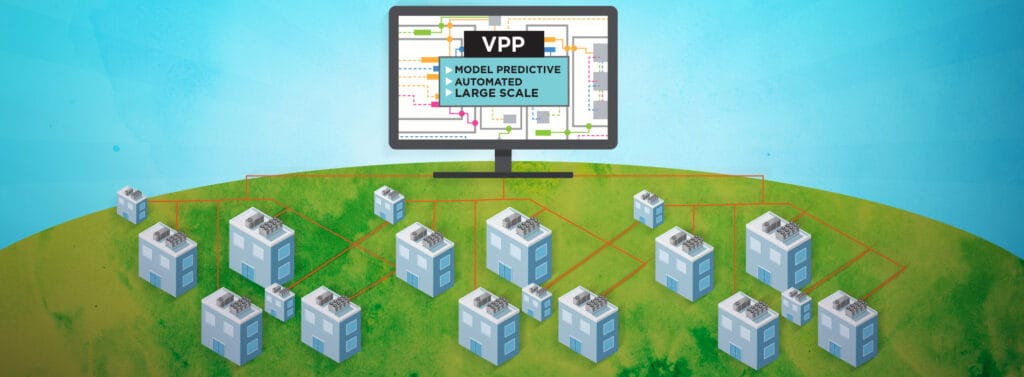
Virtual power plants (VPPs) aggregate and coordinate distributed energy resources across many buildings to act as a single, flexible grid resource. By using advanced controls and predictive algorithms, VPPs can reduce or shift electricity demand during peak periods while maintaining comfort and operational performance.
Through Powering Yolo Forward, WCEC and its partners are demonstrating how public buildings and campus facilities can participate in a community-scale VPP. This approach helps reduce peak demand, lower energy costs, and support a more reliable and sustainable electric grid. You can read more about this project below.
POWERING YOLO FORWARD
Powering Yolo Forward aka “YOLO VPP” is a California Energy Commission-funded project led by the Western Cooling Efficiency Center in partnership with UC Davis, the City of Davis, Yolo County, and Olivine, Inc.
The project is focused on developing and demonstrating a community-scale virtual power plant using public buildings and campus facilities. By coordinating cooling systems and other flexible loads, the project aims to show how local governments and institutions can participate in grid operations.
Current activities include:
- Deploying SPARC-DR, a predictive control platform for managing building loads
- Enrolling rooftop HVAC units and central plant systems across participating facilities
- Integrating building systems with virtual power plant operations
- Coordinating with a VPP operator to enable participation in grid services
- Conducting outreach and engagement with project partners and stakeholders
As the project progresses, this work will generate insights into system performance, operational strategies, and pathways for scaling virtual power plants in other communities.
Contact the Project Manager
cwmande@ucdavis.edu